A Moncton collection and a nearby-city delivery are two property assessments. A street-parking notice at the origin does not answer driveway or building questions at the destination. This guide helps you use the City’s current information, identify the accepted loading position and keep both access records in one clear service request, with a published company contact for the actual route.
| Move detail | Question | Preparation |
|---|---|---|
| Instructions | Are important details understood in writing? | Agree communication and consistent labels. |
| Route | Which municipalities and stops are included? | Provide full civic addresses. |
| Building | Do both windows allow the actual work? | Share current loading and lift instructions. |
| Packing | Which goods and tasks are included? | Survey all storage areas and fragile items. |
| Delivery | What happens if arrival changes? | Confirm updates, receiving and storage alternatives. |
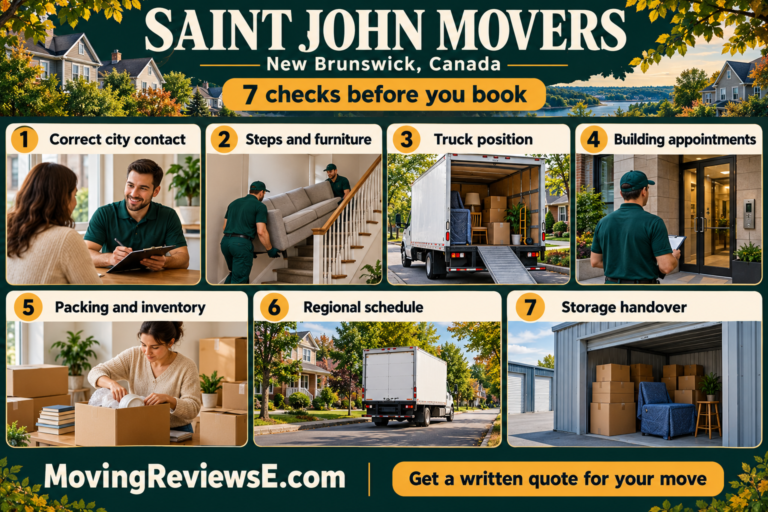
1. Confirm the published Moncton contact
East Coast Moving’s official contact page lists a Moncton address at 184 Barker Street and phone 506-858-1000. Ask directly about your requested dates, both addresses and the tasks needed. A published office is a research contact, not confirmation of available capacity or an independent quality ranking. Request the contracting business name and a named person for estimate and delivery questions.
Explain whether you need a household relocation, selected furniture, professional packing or a staged move. Ask where the assigned crew starts and whether another carrier handles any part of the shipment. Keep the enquiry and inventory version with the offer. If an address, building appointment or substantial item changes later, have the revised scope acknowledged. This is more reliable than expecting every household member and estimator to remember the same details from an initial telephone conversation.
2. Make communication and instructions unambiguous
Agree which written version of the Moncton request the booking contact and receiving person will use. If the household asks for French or English communication, confirm what the company can provide. Do not infer language support from its location. Important instructions should be understood by the people who authorize loading and placement, even when the first enquiry was made by a different relative.
Use the same room labels in the inventory and the receiving plan. If a family member translates the instructions, check addresses, dates and excluded items explicitly rather than relying on a general summary. The aim is one accepted scope, with any changes acknowledged in that version, rather than several conversations giving the crew different destinations or preparation duties.
3. Separate nearby-city routes and dispatch travel
For a Moncton collection and a destination elsewhere in the area, identify the municipality on each access record. The origin’s paid-parking system or street notice does not determine the destination driveway arrangement. Give the carrier both records before asking whether the proposed service can meet a receiving appointment.
If another pickup is added, identify whether it changes the stop order, vehicle space or preparation. Ask for a revised proposal that includes the accepted work. A comparison should not use an earlier one-stop Moncton estimate against a later multi-stop offer. Keep dispatch information supplied by the company separate from your own route description, so the total follows its actual agreed service rather than an assumed starting point.
4. Check loading, stairs and building windows
Photograph the route from the approved truck position to the furniture at both properties. Include driveway turns, overhead obstacles, exterior steps, corridor doors and stair landings. Give current vehicle clearance information to the mover and let it assess suitability for its intended truck. A resident parking garage or nearby empty space is not automatically an approved loading solution.
For managed buildings, obtain the current loading and elevator instructions, including reservations, keys, padding and provider documents requested. Ask whether both windows fit the actual preparation, loading and travel. For public-street loading, check the relevant authority’s requirements for that location and agree who handles any necessary arrangement. Name the person who admits the crew if you are collecting keys elsewhere. A lift reservation does not demonstrate furniture fit or resolve every curbside question, so keep those access checks separate in the estimate.
5. Survey household extras and packing tasks
Walk through garages, sheds, storage lockers and closets along with the main rooms. Identify heavy furniture, tools, exercise equipment and fragile collections during the survey. Mark goods being sold, donated or left behind. Ask the provider which unusual or restricted goods it accepts and what preparation applies to liquids, batteries, plants or equipment that may contain fuel.
Separate self-packed boxes from professional packing and ask which materials and labour are included. Clarify dismantling, reassembly, technical disconnection and final placement rather than inferring all tasks from a full-service description. Give measurements for bulky furniture and check the complete destination route as well as the final room. Keep labelled hardware with the relevant item as instructed. Pack documents, medication, chargers and immediate supplies separately so the household does not depend on finding a particular carton at the end of a long day.
6. Prepare the travel and receiving backup
Update the mover if construction, blocked access or conditions change the property shown during the survey. Agree who prepares a clear walking route and how goods are protected during exposed loading. For current provincial travel information near the date, consult New Brunswick 511 while leaving commercial vehicle routing and operating decisions to the carrier. Do not use a personal-car map duration as a guaranteed delivery promise.
Ask who communicates a changed arrival and what notice the receiving person gets. If delivery is a window, ensure someone can admit and direct the crew throughout the agreed period. Explain firm deadlines before booking and ask what the provider can actually commit to in writing. If key release or a building appointment is uncertain, agree waiting, holding or storage alternatives and how additional work is approved. Do not assume the vehicle can remain loaded overnight without a specific arrangement.
7. Compare storage through final placement
If collection and possession dates do not match, ask for the full staged sequence. Identify the holding business, inventory record, access to individual belongings and notice needed for release. Clarify how final delivery is booked and whether a changed destination requires another access survey. Ask how protection and responsibility apply when goods are handed between crews or facilities.
Compare collection, unloading, holding, later loading, transport and placement together rather than treating a monthly storage figure as the complete moving cost. Label groups for different destinations before collection and keep essentials with you. At final delivery, use a room plan and compare the goods with the inventory, documenting concerns clearly. Retain the offer, booking, receipts and messages so an invoice question or missing-item enquiry can be tied to the tasks and changes actually authorized with the contracting business.
Read Moncton’s current street proposal and operating notice separately
Moncton’s parking-restrictions page includes location-specific changes, some described as proposed and others as implemented or temporary. Read the status for the actual street; do not treat every entry as an approved moving-truck arrangement. The parking page identifies public parking systems, but a payment facility does not establish exclusive loading space.
There is a separate operational check in winter. The City’s snow-clearing guidance explains that overnight street parking may be restricted when clearing is expected or taking place, and directs residents to current parking-ban alerts. Use the current notice for the appointment. An absence of a permanent winter restriction is not a promise that a vehicle can remain at the curb during an operation.
For the moving request, identify the selected loading side, entrance and time constraint. Send photographs showing the signs, rather than naming a street and asking the crew to find somewhere. The company can assess the carrying route from a specific lawful position. If that position changes, update the access description before comparing the revised offer with another provider’s proposal.
A Moncton pickup and nearby-city delivery are two access assessments
Imagine an illustrative collection from a Moncton apartment with a destination in a different nearby municipality. The company may advertise service across the region, but the origin’s parking information does not determine the destination’s rules. This example does not assign an actual street, duration or price to the journey.
Give the estimator two records: one for Moncton loading and one for the receiving property. State the municipality and civic address on each. If the origin has a public-street position and the destination a private driveway, the checks differ. At the origin, the unresolved issue may be where the truck can stand. At the destination, it may be whether the intended vehicle can turn and unload without blocking shared access.
Ask the provider to identify which assumptions are fixed and which still await confirmation. A regional service area does not resolve either access issue. If the receiving person supplies new photographs after the first offer, have the operator reassess that stage before acceptance. Do not add an informal longer-carry estimate yourself or expect the driver to redesign the unloading plan after arrival.
Use an agreed written form for important instructions. If the household prefers French or English communication, ask what the business can provide and ensure the relevant contacts understand the final version. Do not infer a language service from the city or the business name. Destination labels should use the same room names as the receiving person’s placement plan, regardless of which language was used for the first enquiry.
The request builder can retain both access records and the actual service description. Compare the full proposals after each provider has priced the same origin, destination and accepted stops. That produces a meaningful regional comparison, instead of a Moncton estimate whose receiving half remains an untested assumption.
Moncton moving questions
Should I specify the municipality for a nearby destination?
Yes. Supply the full civic address and municipality for every stop. Ask how dispatch and travel are treated in the actual offer rather than assuming nearby-city coverage determines the whole calculation.
Can I ask for booking instructions in my preferred language?
Ask what the company can provide and confirm important details in an agreed written form. Do not infer a language service from location alone, and make sure the crew and receiving contact understand destination labels.
What should I confirm about a longer delivery date?
Ask whether arrival is an appointment or a window, whether goods change vehicles or enter storage, and who sends updates. Agree receiving access and a fallback before collection, keeping essentials with you.
More New Brunswick guides: Saint John moving guide · Fredericton moving guide · All New Brunswick guides.
See the federal Office of Consumer Affairs moving advice for further preparation guidance.
Research checked: October 27, 2026. Based on linked official company and public-information sources. We have not hired or independently tested these providers. Contacts and coverage can change; confirm dates, addresses and tasks directly. This is a practical guide, not a live price, quality ranking or exhaustive provider list.