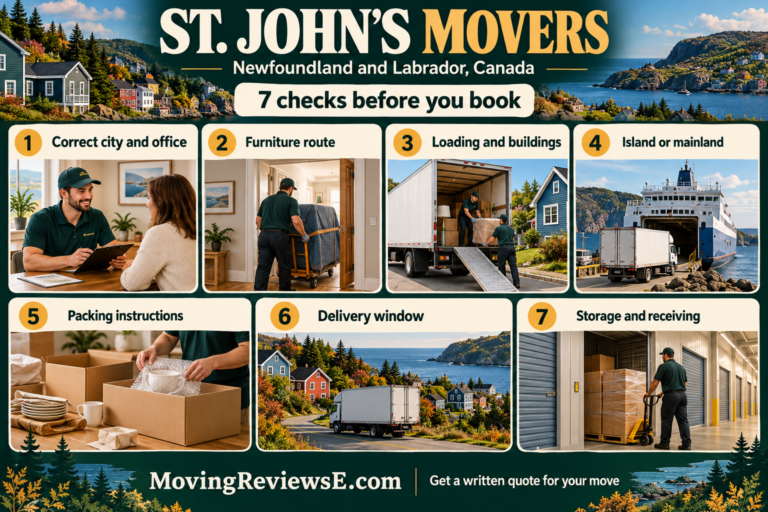
A Corner Brook downsizing move is not complete when unwanted furniture is simply removed from the transport list. Each large piece needs an accepted destination, whether that is the new room, storage or another removal arrangement. This guide connects a published moving contact with local bulky-waste information and an illustrative cabinet-and-sofa decision, so the final request describes the whole property handover.
| Move detail | Question | Preparation |
|---|---|---|
| Driveway | Is the proposed truck suitable? | Show slope, surface, gates and turning space. |
| Furniture | Has the full carrying route been assessed? | Measure doors, stairs and destination room. |
| Workshop | What preparation or acceptance is required? | List heavy equipment and follow instructions. |
| Route | Is a marine stage actually involved? | Ask for the carrier's actual journey. |
| Storage | Who holds and later delivers the goods? | Record inventory, release notice and responsibility. |
1. Verify the Corner Brook branch contact
Household Movers’ official contact page lists its Corner Brook branch at 5 Lundrigan Drive, with 709-634-2434 and rick.piercey@hhmovers.ca. Ask directly about your dates, addresses and required work. The published branch details provide a research contact, not available capacity or an independently tested quality ranking. Request the contracting business name and a named person for estimate and delivery questions.
Explain whether you need a local household transfer, packing, selected furniture or a shipment beyond the island. Ask where the assigned crew starts and whether another carrier performs any stage. Keep the enquiry and inventory version with the written offer. If the route or property changes later, have the revised arrangement acknowledged before collection. This avoids comparing a new service against an old figure that assumed different goods, a different truck position or an easier receiving appointment.
2. Assess slopes, driveways and vehicle turning
Photograph the approach from the road to the proposed truck position. Include surface, slope, gates, overhead obstacles, narrow turns and available turning space. Ask the provider to assess its intended vehicle rather than assuming a driveway accessible to your car is suitable for every moving truck. Explain shared access and identify where residents, neighbours or other vehicles must still pass during loading.
Describe the carrying route beyond the vehicle, including exterior steps, side paths, basement entrances and distance to the goods. If the main truck cannot reach the home, ask for the alternative handling method and calculation basis before booking. A smaller vehicle or longer carry should be part of the written plan. For public-street loading, check the relevant authority’s requirements for the actual location. Give every provider the same access record so competing offers do not silently assume different vehicle positions or amounts of carrying work.
3. Survey stairs and furniture fit separately
For a Corner Brook downsizing move, check whether the furniture fits the smaller destination before deciding what travels. Record the complete route into the final room, not only the front doorway. A cabinet may be useful at the new home but still need a preparation or fitting assessment at a stair turn.
Give the provider the accepted destination of each substantial piece. If a fitting question remains unresolved, mark the item as provisional rather than silently including it in both the home and storage groups. Ask how the final choice affects the proposed service before accepting the offer. The worked example below separates that cabinet decision from an old sofa’s removal, because they require different recipients and handling arrangements.
4. Include workshops and goods outside the main rooms
Inventory goods outside the main rooms according to their destination: new home, another recipient or a separate removal arrangement. A garage may hold ordinary household storage alongside materials the carrier needs to assess before acceptance. Show contents clearly rather than placing everything under one garage line.
For objects that will not travel, confirm what happens before the property handover. Corner Brook’s ordinary weekly collection does not cover every bulky item, so exclusion from the moving list is not itself a disposal plan. Keep refused or unconfirmed goods away from the accepted loading route and ask the relevant service about actual acceptance. The transport provider should not have to decide which apparently unwanted object the household intended to keep.
5. Distinguish island routes from marine stages
Give full addresses and ask the carrier to explain the actual service route. A move between communities on Newfoundland should not be assigned a mainland crossing simply because the province is an island destination. For a mainland connection, ask which marine stage and terminals are proposed and how collection, terminal travel and onward delivery are coordinated. Your household’s passenger journey may differ from the shipment’s commercial arrangements.
If Marine Atlantic is part of the plan, use its official commercial information for context and have the mover explain responsibility. Ask who arranges the crossing and how marine charges, waiting, changes or interrupted travel affect the written offer. Do not use a passenger-car fare or an unverified sailing to predict the shipment’s price or arrival. Confirm delivery as an appointment or window and identify who sends updates to the receiving person.
6. Define packing and managed-building access
Separate self-packed cartons from professional packing, identifying fragile collections, artwork and delicate equipment. Ask what materials and labour are included, how unused supplies are treated and what unpacking covers. Request instructions and protection terms for goods you prepare yourself. Keep medication, documents, chargers and immediate supplies outside the shipment, especially if delivery follows a different schedule from your own journey.
For managed buildings, obtain current loading and elevator rules, including reservations, keys, clearances, receiving windows and provider documents requested. Ask whether appointments fit the actual inventory and travel. Update the mover if access changes after the survey. Consult Newfoundland and Labrador 511 near the date for current provincial travel information while leaving truck routing and operating decisions to the carrier. Agree how changed conditions or an unavailable lift affect the receiving plan and approval of additional work.
7. Compare possession and storage as one sequence
Confirm actual key release and destination readiness. If collection and possession do not match, ask about waiting, holding or storage before accepting a tightly timed plan. Do not assume the vehicle can remain loaded overnight without an explicit agreement. Identify who can authorize a change and how extra handling or a revised delivery is documented and priced.
For storage, compare collection, unloading, holding, later loading, transport and final placement together. Ask which business holds the goods, how inventory is recorded, whether individual belongings can be retrieved and what release notice is required. Clarify protection and responsibility across handovers. Prepare room labels and a receiving contact for delivery, then compare the goods with the inventory and document concerns promptly. Keep the offer, booking, receipts and messages together so an invoice or shipment question can be tied to the tasks and changes actually authorized.
Corner Brook furniture removal is not ordinary weekly garbage collection
The City’s garbage and recycling guidance states that bulky items such as furniture and appliances are not collected through the ordinary weekly service. Its special-waste page describes date-specific programmes. Check the current programme and acceptance directly; an old spring collection announcement does not establish that a sofa can be left out on the date of an autumn move.
This gives a downsizing household three separate decisions: furniture accepted in the moving shipment, goods going to a confirmed recipient, and items needing another removal arrangement. Do not combine the last group with ordinary packed belongings or assume the moving crew will dispose of it. If removal is required from the same provider, ask for that task and its destination to be described separately.
The published Corner Brook branch contact is useful for the transport enquiry, but a moving-office address does not establish access to a municipal waste programme. Likewise, municipal acceptance does not establish that a contractor’s vehicle can use every option on the same terms as a resident. Check the actual arrangement before taking the furniture off the accepted inventory.
A downsizing example with a cabinet and an excluded sofa
Imagine an illustrative Corner Brook household moving a cabinet to a smaller home while removing an old sofa through another arrangement. This is not a customer report or a claim about a provider’s disposal service. The cabinet’s fitting assessment and the sofa’s final destination should be settled before the move is priced as a complete job.
Measure the cabinet’s final room and the route into it. If it fits the room but not the stair turn, ask the mover to assess preparation or another accepted method; do not keep it in the shipment merely because it is useful furniture. If the household instead chooses storage, identify that as a changed destination with its own handling and release arrangements.
For the sofa, confirm the recipient or removal service and its date. Do not put it at the curb prematurely while waiting for a later programme. Keep it away from the agreed furniture route so the moving crew can identify which pieces travel. If the other collection fails, notify the transport provider before arrival and ask which revised service, if any, it can offer.
Now compare quotes using the same accepted cabinet plan and the same sofa exclusion. An offer that takes the cabinet only to a ground-level entrance is different from one placing it in the assessed final room. An offer that omits the sofa’s separate removal is different from a combined service that explicitly accepts it. The item names alone are not a complete description of either proposal.
Record move, storage and removal as separate destination groups in the inventory tool. The benefit is a Corner Brook downsizing plan with no orphaned furniture at handover: each piece has an accepted route and recipient, and the household is not relying on weekly garbage service to solve a bulky-item decision it does not cover.
Corner Brook moving questions
What should I provide for a difficult approach?
Send current photographs showing surface, slope, gates, turns, overhead obstacles and the route from the truck to the goods. Ask the mover to assess the intended vehicle and describe any alternative handling before booking.
Should workshop goods be surveyed separately?
Include them in the complete shipment and identify heavy equipment or preparation needs explicitly. Request acceptance instructions for questionable contents and mark goods that will stay, be sold or travel to another destination.
What should I confirm about mainland delivery?
Ask for the actual route, marine responsibility, included charges, delivery window and update contact. Clarify transfers or storage and how changed travel affects receiving access, keeping essential belongings with you.
More Newfoundland and Labrador guides: St. John’s moving guide · Gander moving guide · All Newfoundland and Labrador guides.
See the federal Office of Consumer Affairs moving advice for further preparation guidance.
Research checked: October 27, 2026. Based on linked official company and public-information sources. We have not hired or independently tested these providers. Contacts and coverage can change; confirm dates, addresses and tasks directly. This is a practical guide, not a live price, quality ranking or exhaustive provider list.